
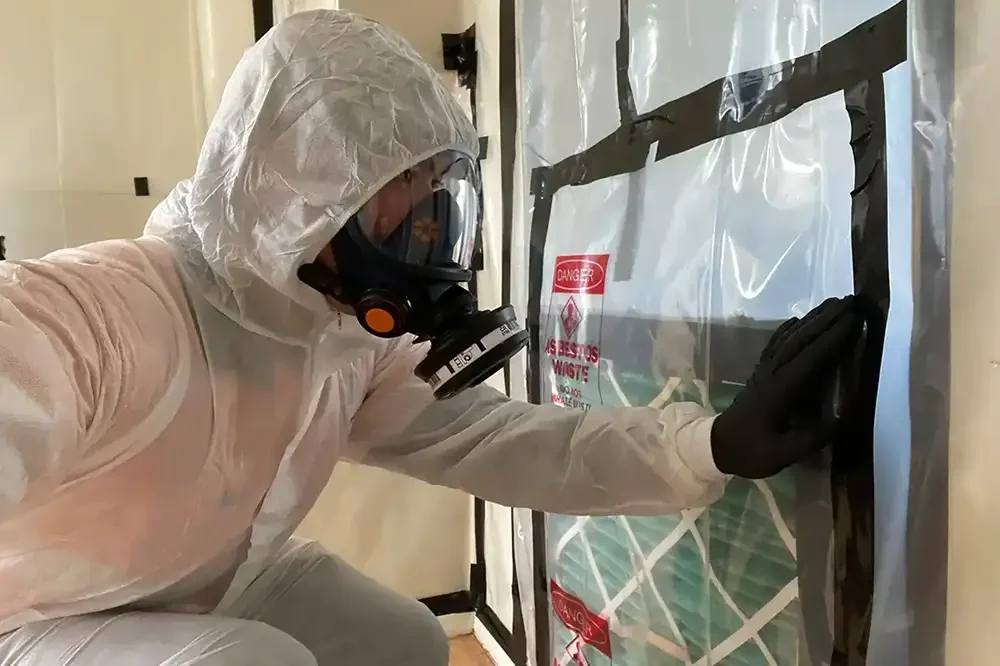
Asbestos Services
Asbestos Consulting, Surveying & Clearances

Asbestos Surveys
Our experienced and qualified surveyors (IP402) will identify the asbestos-containing materials at your site.
There are seven main types of asbestos surveys we provide, each with a different purpose.
Asbestos Management Survey
Asbestos Refurbishment Survey
Asbestos Demolition Survey
Asbestos in Soil Survey
Asbestos Condition Assessment
Asbestos Fire Damaged Building Survey
Asbestos Sample Testing
Direct Hazmat Consultants will provide a survey tailored to meet your requirements, which may be a mixture of survey types. Our asbestos surveys are conducted in accordance with the WorkSafe 2026 Good Practice Guidelines “Conducting Asbestos Surveys”.
01
Asbestos Management Surveys
An asbestos management survey of a workplace or home allows the PCBU to identify all asbestos containing materials which may be disturbed during normal activities. This is a requirement under Regulation 10 of the Health and Safety at Work (Asbestos) Regulations 2016.
Direct Hazmat Consultants will prepare a report which includes an asbestos register detailing the asbestos location, extent, product type, condition, surface treatment, and accessibility. This information will then be used to formulate your own asbestos management plan for your site.
04
Asbestos in Soil Survey
Our asbestos in soil assessments determine whether soil has been impacted by asbestos and if it exceeds the BRANZ New Zealand Guidelines for Assessing and Managing Asbestos in Soil. These assessments are commonly undertaken before demolition and redevelopment.
Our assessments includes a site inspection, soil sampling, laboratory analysis by an IANZ-accredited laboratory, interpretation of the results against the BRANZ Guidelines, and a comprehensive report with site plans and practical recommendations where required.
07
02
Asbestos Refurbishment Surveys
An asbestos refurbishment survey is required before any de-construction work is commenced on a structure that was built before the year 2000. This is a requirement under Regulation 25 of the Health and Safety at Work (Asbestos) Regulations 2016.
The survey targets only areas which are to be disturbed during the refurbishment work. The survey is fully invasive, which means the walls, floors and ceilings may need to be opened and inspected.
Our report will provide you with sufficient information to prepare for the removal of any asbestos-containing materials prior to work taking place.
05
Asbestos Condition Assessment
Asbestos condition assessments are carried out to evaluate the condition of known asbestos-containing materials (ACMs) and determine whether they remain in a safe and stable condition. These assessments help identify any deterioration or damage that may require remedial action and support the ongoing management of asbestos within a building.
Following the inspection, we provide a detailed report outlining the condition of the ACMs, recommended actions where required, and information to assist with updating your Asbestos Management Plan.
Asbestos Sample Testing
If you have a material that you would like tested for asbestos, we can arrange laboratory analysis for you.
If you bring a sample into our office, the cost is $75 + GST per sample. Please ensure all samples are securely sealed in a plastic bag before bringing them in.
If you're unable to collect a sample yourself, one of our experienced consultants can visit your property and safely collect the sample for you. Simply give us a call, and we'll be happy to provide a quote based on your location and requirements.
03
Asbestos Demolition Surveys
The purpose of a demolition survey is to locate all asbestos containing materials before demolition work commences. It is a fully invasive survey in which the surveyor will need to penetrate the building structure to inspect all areas and building materials. For this reason, demolition surveys are normally undertaken in vacant buildings with all services disconnected.
An asbestos demolition survey is required under Regulations 21 and 22 of the Health and Safety at Work (Asbestos) Regulations 2016 of any structure built before 2000.
Our report will provide you with sufficient information to prepare for the removal of the asbestos materials prior to the demolition of the building.
06
Asbestos Fire Damaged Building Survey
Following a fire, asbestos-containing materials can become damaged, with contaminated debris spreading throughout the building and surrounding area. Our fire-damaged asbestos surveys identify the presence of asbestos and determine the extent of contamination, ensuring the appropriate controls can be put in place before clean-up, remediation, or demolition work begins.
Our experienced consultants inspect fire-damaged properties, collect samples for analysis by an IANZ-accredited laboratory, assess the extent of contamination, and provide clear recommendations for the safe management of the site. We also inspect surrounding areas for asbestos debris and document our findings with photographs and site plans.
All surveys are completed in accordance with current New Zealand guidance and industry best practice.
Asbestos Clearances
Our team of independent Licensed Asbestos Assessors provides professional asbestos clearance inspections for projects of all sizes across New Zealand.
By law, all Class A asbestos removal work, and many Class B removal projects, require an independent asbestos clearance certificate to verify that the removal work has been completed satisfactorily and the area is safe for reoccupation.
With one of the largest teams of Licensed Asbestos Assessors in the lower North Island, we have the capacity to respond quickly and support projects ranging from small residential removals to large commercial developments. We work closely with asbestos removal contractors, property owners, government agencies, insurers, and project managers to ensure projects are completed efficiently and in accordance with current best practice.
Our Class A clearance inspections are undertaken in accordance with the latest WorkSafe Good Practice Guidelines and include the four-stage clearance process:
Stage 1 Preliminary check of site conditions and job completeness.
Stage 2 Thorough visual inspection of the work area.
Stage 3 Dust disturbance and clearance air monitoring.
Stage 4 Final assessment following dismantling of the enclosure or work area.

We also undertake Class B asbestos clearances, which include a comprehensive visual inspection of the work area to confirm all asbestos-containing materials have been removed. Where appropriate, clearance air monitoring may also be carried out to provide additional reassurance or where required by the project specification.
All air samples are analysed by an IANZ-accredited laboratory, providing accurate, independent results and giving you confidence that the area is safe for reoccupation.

Asbestos Management Plans
An asbestos management plan is prepared after the completion of the asbestos survey. The plan sets out the location of the asbestos-containing materials at the site and how they are to be managed. The plan is a legal requirement under Regulation 13 of the Health and Safety at Work (Asbestos) Regulations 2016 and must be reviewed at least every 5 years.
Asbestos management plans typically consist of the following management strategies:
Label – Labelling and managing the asbestos-containing materials
Sealing – Applying a protective coating (e.g. paint) over the material
Encapsulation – Overlaying a hard material over the asbestos
Enclosing – Building a barrier around the material
Removal – Removal of the asbestos by a licensed asbestos removalist
Deferral – No immediate action required. Periodically monitoring the condition of the material for any changes


Asbestos Air Monitoring
Asbestos air monitoring involves sampling the air to determine if there are any respirable asbestos fibres present. Types of asbestos air monitoring we provide include:
Control
Background – Samples are taken before asbestos removal work begins, to determine the background levels
Leak – Taken during asbestos removal works (Class A and sometimes Class B) to ensure controls are working and the workers are safe
Reassurance – Taken from locations where asbestos is present to determine if the materials are becoming airborne
Boundary – Boundary air monitoring is a form of reassurance air monitoring. It occurs around the boundary of the removal work area as reassurance to neighbouring property owners that their property is not being contaminated with airborne asbestos fibres
Personal – Personal samples are taken from the workers during asbestos removal works to ensure the level of respiratory protection is adequate
Clearance
Air – Air samples are taken inside the enclosure after the asbestos removal works have finished to ensure the area is safe for re-occupation
Is Air Monitoring Mandatory?
In New Zealand, asbestos air monitoring is mandatory for Class A asbestos removal. For Class B asbestos removal, air monitoring is discretionary, and is often carried out at educational facilities and other sensitive occupied locations.

Get in Touch
We would love the opportunity to help you, whether it’s a problem in your home, at work, or on a building site. If you would like a quote or have any questions, please complete the form below and one of our team will be in touch as soon as possible.
86 Aorangi Street, Feilding 4702
Email: admin@directhazmat.co.nz
Phone: 0800 1 HAZMAT (0800 1 429628)